

Your RCD keeps tripping: what it means and what to do
Your RCD is a life-saving device, not a nuisance. Here is what repeated tripping usually means, the safe way to narrow it down to one appliance, and the point at which you should stop and call an electrician.
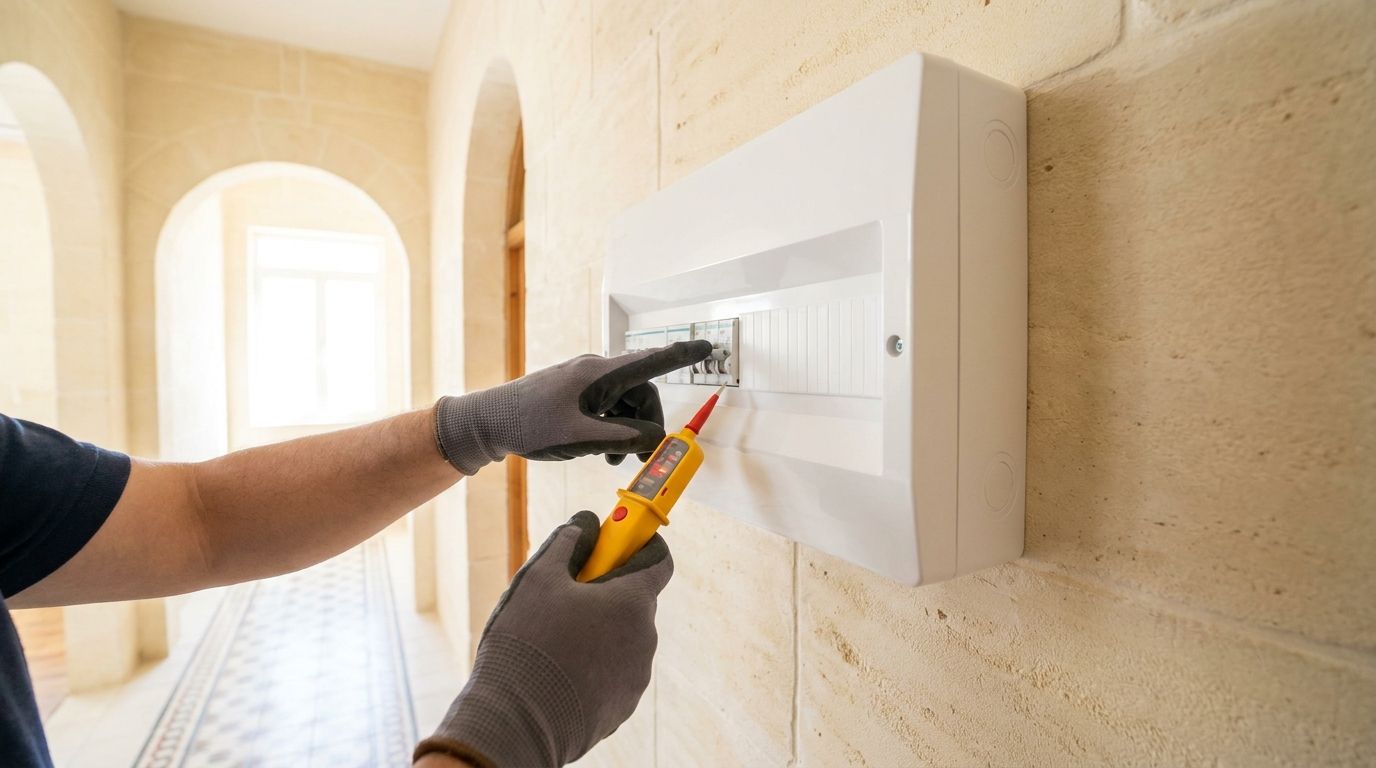
If anyone has had a shock, is unconscious, is burned, or there is fire or smoke, ring 112 before you do anything else. Do not touch a person who may still be in contact with live electricity. Do not go back to the consumer unit to "try one more reset". The rest of this page is for the situation where nobody is hurt and the lights have simply gone out.
What an RCD actually does
An RCD — the trip switch in your consumer unit that cuts the power rather than just blowing a fuse — is a life-safety device. The UK Health and Safety Executive (foreign source, but the physics does not change at the Maltese border) states that an RCD rated at no more than 30 mA limits the energy in a particular type of electric shock and can save your life. Devices rated above 30 mA give very limited shock protection.
Two further points from the same HSE guidance are worth knowing before you start poking at anything:
- An RCD cannot protect against every type of shock. It is a safety net, not a guarantee.
- It is best fitted in the main switchboard, where it covers all circuits. A plug-in or socket-type RCD protects only what is plugged into it, and nothing else.
So when your RCD trips, something has made it decide that cutting the supply was safer than leaving it on. That is the device working. The question is what triggered it.
Why it keeps tripping
Electrical Safety First, the UK charity (foreign source), is blunt about this: repeated tripping most likely means there is a fault either in an appliance or in the wiring itself, and a registered electrician should investigate.
That is the short version. Before you get to an electrician, there is one test a householder can reasonably do, and it comes from UK guidance.
The unplug-and-reset test (UK guidance — no Maltese equivalent published)
We could not find a Maltese source that sets out this procedure. What follows is UK local authority guidance, from the City of York Council and Wandsworth Borough Council, and we are labelling it as foreign so you know exactly where it comes from.
The York guidance applies only to a modern consumer unit. If what you have is an old fuse board, leave it alone and call an electrician. It also says plainly: if you are unsure, or unsteady on your feet, do not attempt it.
- Find the switch that is in the off position and push it up.
- If it trips again, unplug all appliances on the affected circuit and reset.
- Switch the lights on one at a time. If it trips when a particular light goes on, that bulb or fitting is the likely fault.
- Plug the appliances back in and switch them on one at a time. If it trips when a particular appliance goes on, that appliance is the likely fault.
- Unplug the faulty item and stop using it. Wandsworth's guidance says to stop using the item that trips the switch and consult an electrician.
- If it still keeps tripping with everything unplugged, stop and call for a repair.
Wandsworth adds the warning that matters most here: if the switch will not stay on, stop resetting it. Repeatedly resetting without fixing the cause can create electrical hazards.
Never bypass an RCD
Electrical Safety First reported on ERA Technology testing of 607 RCDs in social housing. Over 96% of them worked. The failures came from deliberate shorting, foreign material in the device, misalignment and contact welding — and six of the units had been deliberately shorted out specifically to stop nuisance tripping.
That is someone removing the thing that would have saved a life, because it was being inconvenient. Do not tape an RCD in the on position, do not wedge it, do not let anyone "sort it out" by shorting it. If it is tripping, that is information, not a defect.
Separately, HSE guidance says that a faulty RCD should be removed from use. An RCD whose test button does not work is itself the fault — Electrical Safety First says to get an electrician in that case.
Press the test button every three months
Electrical Safety First's guidance is to press the RCD test button every three months and confirm that it trips. Their survey found most householders had never tested theirs at all. HSE likewise says to press the test button regularly and confirm it trips.
Again: no Maltese source we found sets a test interval. Three months is UK guidance. It is still a sensible habit in a Malta flat or a Gozo farmhouse.
Call an electrician promptly if you see any of this
Electrical Safety First lists these as reasons to call an electrician promptly:
- Burn marks on plugs or sockets
- Buzzing or crackling sounds (arcing)
- Blown fuses
- Tripping circuit breakers
- An RCD test button that does not work
Two habits from the same source, worth fixing while you are at it: use one extension lead per socket, and never plug one extension lead into another.
Who is allowed to do the work in Malta
This part is Maltese, and it is the part the UK sources cannot tell you.
The Regulator for Energy and Water Services (REWS) authorises electricians in two classes only:
| Class | Scope |
|---|---|
| Authorisation A | Install, alter, extend and certify single-phase installations |
| Authorisation B | Single-phase plus three-phase installations under 300 A per phase, including certification |
Warranted electrical engineers holding A or B get an extended scope: grid-tied generators such as PV, and, for B, no amperage limit.
There are no classes C or D. If you have been told otherwise, the REWS page does not support it.
REWS publishes public lists of Authorised A electricians, Authorised B electricians and warranted engineers, updated 12 October 2026, so you can check a name against the list before anyone touches your consumer unit. The governing law is the Electrical Installations Regulations, S.L.545.24, with a 2024 amendment consultation now closed. Malpractice can be reported through REWS Dispute Resolution; REWS can be reached on +356 2295 5000 or at enquiry@rews.org.mt.
For a landlord, that list is the practical answer to "how do I know the person I sent to the Sliema flat was allowed to certify it". Check the name. It takes a minute.
Common questions
- Can I just tape the RCD on or bypass it so it stops tripping?
- No. Electrical Safety First (UK charity, foreign source) reported on ERA Technology testing of 607 RCDs in social housing, in which six had been deliberately shorted out to stop nuisance tripping. Deliberate shorting was one of the causes of failure found. An RCD that has been bypassed cannot protect anyone. If yours trips repeatedly, the fault needs finding, not silencing.
- How often should I press the test button?
- UK guidance from Electrical Safety First (foreign source) is to press the RCD test button every three months and confirm it trips. The UK Health and Safety Executive (foreign source) likewise says to press the test button regularly and confirm it trips. We found no Maltese source setting a test interval, so treat the three-month figure as UK guidance rather than a Maltese rule.
- How do I check an electrician is properly authorised in Malta?
- REWS, the Regulator for Energy and Water Services, publishes public lists of Authorised A electricians, Authorised B electricians and warranted electrical engineers, so you can check a name against them. There are two authorisation classes only: A covers single-phase installations and B covers single-phase plus three-phase under 300 A per phase.
- The RCD trips again the moment I reset it. What now?
- Stop resetting. Wandsworth Borough Council (UK local authority, foreign source) warns that repeatedly resetting a switch without fixing the cause can create electrical hazards, and that if the switch will not stay on you should stop and get a repair. Call an electrician.
What we could not establish
- No Maltese source we could find sets out the unplug-and-reconnect test for finding a faulty appliance. The method here is taken from UK local authority guidance and is labelled as such in the text.
- No Maltese source we could find states how often a householder should press the RCD test button. The three-month interval is UK guidance from Electrical Safety First.
- The REWS authorised providers page lists two electrician classes only, A and B, plus warranted electrical engineers. If you have been told there are classes C and D, that is not what REWS publishes.
- We found no Maltese regulatory or safety source using or defining the local term 'salvavita' for an RCD, so we do not treat it as an official term here.
- The sources do not state whether Maltese landlords are legally required to have RCD protection fitted, or at what rating, in rented property. Nothing in the set settles that.
- The sources give no Maltese call-out prices, response times or ferry-related timings for Gozo. We will not invent them.
Sources
- Electrical Installations Authorised Providers — Regulator for Energy and Water Services (REWS), Malta · read 2026-10-26
- Frequently asked questions (electricity at work) — Health and Safety Executive (UK) - FOREIGN SOURCE · read 2026-10-26
- If my RCD keeps tripping, what action is required? — Electrical Safety First (UK charity) - FOREIGN SOURCE · read 2026-10-26
- RCDs put to the test — Electrical Safety First (UK charity) - FOREIGN SOURCE · read 2026-10-26
- Advice about resetting a trip switch — City of York Council (UK local authority) - FOREIGN SOURCE · read 2026-10-26
- Electrical safety in your council home — Wandsworth Borough Council (UK local authority) - FOREIGN SOURCE · read 2026-10-26
Want this costed properly?
The calculator gives you a figure in a minute. A site visit gives you a fixed price.
Book a free survey